Medically reviewed by Dr. Ann Dillon, Optometrist
Your screen might be more innocent than you think.
If you spend your day on a computer, studying, or bouncing between your laptop and phone, you probably know the pattern. Your eyes feel heavy by mid-afternoon, a headache creeps in behind your forehead, and by the end of the day even one more email feels like a lot.
Screens get the blame for eye strain headaches, and they do play a part. For some people, though, the real strain comes from how hard the eyes are working to stay lined up with each other. Your prescription can be perfect and your eyes can still be working overtime.
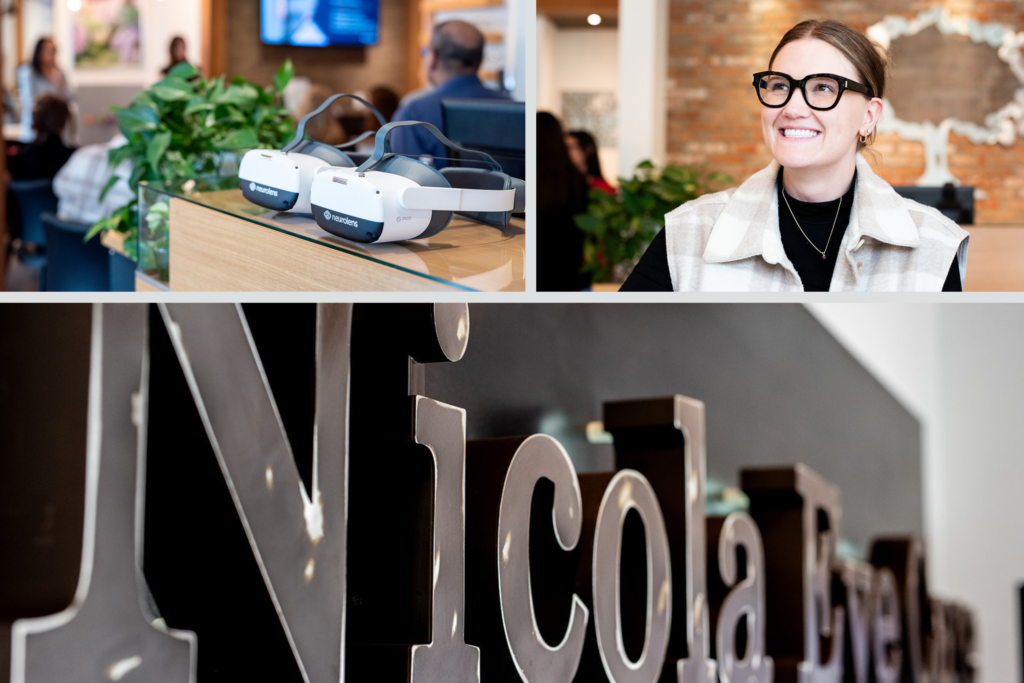
Nicola Eye Care is the only clinic in Kamloops offering Neurolens® in Kamloops, a prescription lens designed for this kind of eye misalignment. Here’s how screen time, eye alignment, and eye strain headaches connect, and how to tell whether your eyes are part of the story.
What is Neurolens?
Neurolens® is a prescription lens that uses contoured prism to help your eyes stay comfortably aligned at different distances. The prism changes from the top of the lens to the bottom, so your eyes get different support when you look across the room than when you read a screen. It’s prescribed after an eye alignment measurement and a comprehensive eye exam.
In short:
- Screen time can trigger eye strain headaches, but it isn’t always the root cause.
- Small eye misalignments make your eye muscles work harder, especially up close.
- Neurolens uses contoured prism to reduce that effort for people who qualify.
- A comprehensive eye exam with a two-minute alignment test shows whether it’s a fit.
Why Do Screens Cause Eye Strain and Headaches?
Looking at something close for hours keeps your eyes’ focusing and teaming systems switched on all day, and computer work leaves very little downtime. Optometry associations call the resulting group of symptoms computer vision syndrome, also known as digital eye strain. It usually comes from several factors stacking up:
- Sustained close focus: Your eyes work constantly to keep text sharp on a monitor or phone.
- Reduced blinking: People blink less when they concentrate on screens, which can leave eyes dry and irritated. If dryness is a regular thing for you, dry eye treatment can help.
- Visual demand: Small text, multiple screens, and switching between them all take ongoing effort.
- Posture: Leaning toward your screen to see better adds neck and shoulder tension.
- Glare: Reflections, bright screens, and poor lighting make viewing harder work.
- Uncorrected prescription: Even a small prescription change can affect comfort at the computer, which is one reason regular eye tests matter.
- Eye coordination: Both eyes need to point at exactly the same spot to give you one clear image, and that job gets harder up close.
Simple habits help some people. The 20-20-20 rule (every 20 minutes, look at something about 20 feet away for 20 seconds), a well-placed monitor, and softer lighting are all worth trying. If your symptoms keep coming back, our digital eye strain treatment in Kamloops starts with a comprehensive eye exam to find the cause instead of chasing short-term fixes.
When the Screen Isn’t the Whole Problem
Ever finished a workday with a headache even though your glasses are up to date? Seeing clearly and seeing comfortably aren’t the same thing.
When you look at something close, your eyes turn slightly inward so they both land on the same point. Some people have a small misalignment that makes this harder, so the eye muscles work extra to keep the image single. Over hours of reading or screen time, that effort can add up to tired eyes, headaches, and trouble concentrating. Optometrists group these issues under binocular vision dysfunction, a term that covers several ways the eyes can struggle to work as a team.
The manufacturer of Neurolens connects this effort to the trigeminal nerve, which carries sensation for much of the face and head. Their explanation is that easing the work of keeping the eyes aligned can ease the symptoms that come with it.
Eye misalignment isn’t behind every headache. Migraines, stress, dehydration, poor sleep, and medical conditions also cause recurring headaches. An eye exam helps show whether your visual system is part of the picture.
What Does Eye Misalignment Feel Like?
Eye misalignment isn’t always obvious. You can pass a vision screening, see clearly, and still feel uncomfortable after an afternoon of focused work.
Signs that can point to a binocular vision issue include:
- Headaches during or after close work, often getting worse later in the day
- Tired eyes that feel more fatigued as the day goes on
- Neck and shoulder stiffness when you read or use a computer
- Dizziness, motion sickness, or discomfort with movement
- Trouble concentrating on reading or screen work
- Words that blur, double, or seem to move on the page
- Losing your place while reading
- Light sensitivity, especially with bright lights like fluorescents or headlights
These symptoms overlap with other eye and health conditions, so having one or more doesn’t mean you have an alignment problem. At Nicola, we start with a short symptom and lifestyle questionnaire so your optometrist can see how often these show up for you. If you’ve already tried screen breaks, brightness changes, or a new prescription without much relief, it’s worth asking about binocular vision testing at your next eye exam.
What Is Neurolens and How Does It Work?
Standard glasses correct refractive errors like nearsightedness, farsightedness, and astigmatism so you see clearly. Neurolens adds contoured prism, which makes it a therapeutic lens designed for eye alignment as well as clarity.
How contoured prism works
Prism lenses bend light slightly before it reaches your eyes. When prescribed for the right binocular vision condition, prism reduces the effort your eyes need to stay aligned.
Traditional prism lenses keep the same amount of prism across the whole lens. Neurolens works differently. According to the manufacturer, the prism gradually increases from the top of the lens toward the bottom, where you look when reading or working on a laptop. That matters because your eyes turn inward more at near distances, so they do a different job reading a document than looking across a room.
How Neurolens differs from regular glasses
- Regular glasses correct how clearly you see.
- Neurolens includes your up-to-date prescription when you need one, plus contoured prism for eye coordination.
- Lens designs include single vision, computer and office lenses, and progressives.
- Frames: Neurolens lenses fit most regular frames, so you can still choose a pair you love.
Neurolens isn’t the answer for every case of eye strain. Some people need an updated prescription, dedicated computer lenses, or IPL for dry eyes instead. Your optometrist will match the treatment to what’s actually causing your symptoms.
Does Neurolens really work?
The research is still growing. A 2024 randomized, double-masked crossover trial published in Translational Vision Science & Technology found that people with moderate to severe headaches reported a statistically significant improvement on a headache quality-of-life questionnaire (HIT-6) while wearing Neurolens compared with control lenses. The trial was funded by the manufacturer, and the average improvement was smaller than the threshold the researchers set for a clinically meaningful change.
In plain terms, the results suggest real benefit for some patients and show that more independent research is needed. The manufacturer also publishes patient-reported results from its own data. Those results are encouraging, but they haven’t been tested in the same controlled way. That’s why we only recommend Neurolens after testing shows it’s a good fit.
What Happens During a Neurolens Test at Nicola Eye Care?
Neurolens testing is built into your comprehensive eye exam, so there’s no separate appointment to book.
- Symptom and lifestyle review: During pretest, we ask about your headaches, screen time, reading habits, and when symptoms show up.
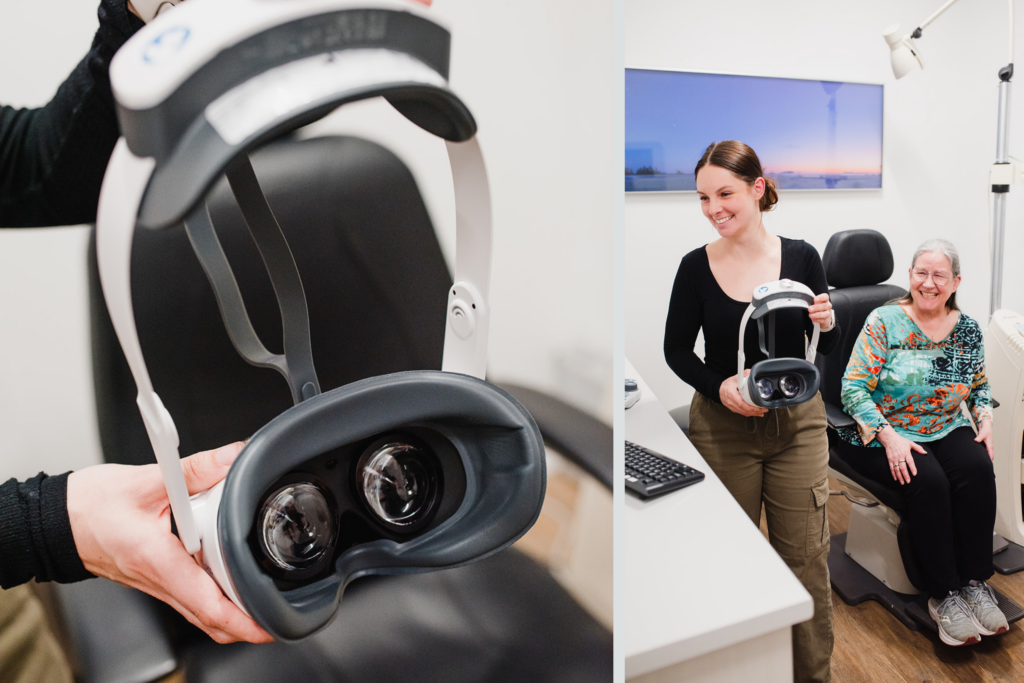
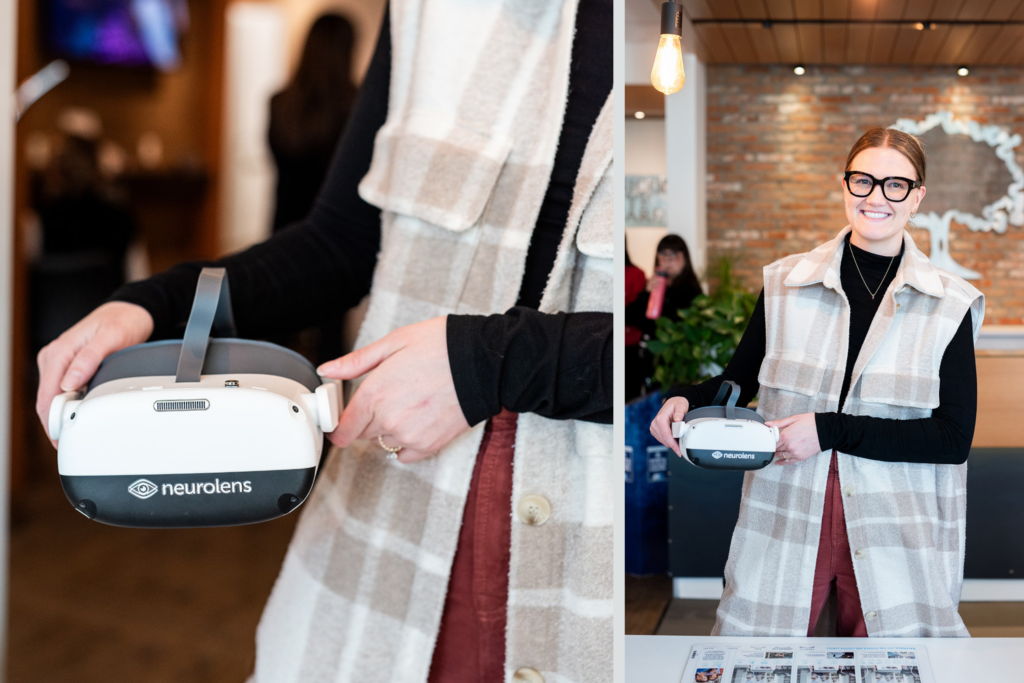
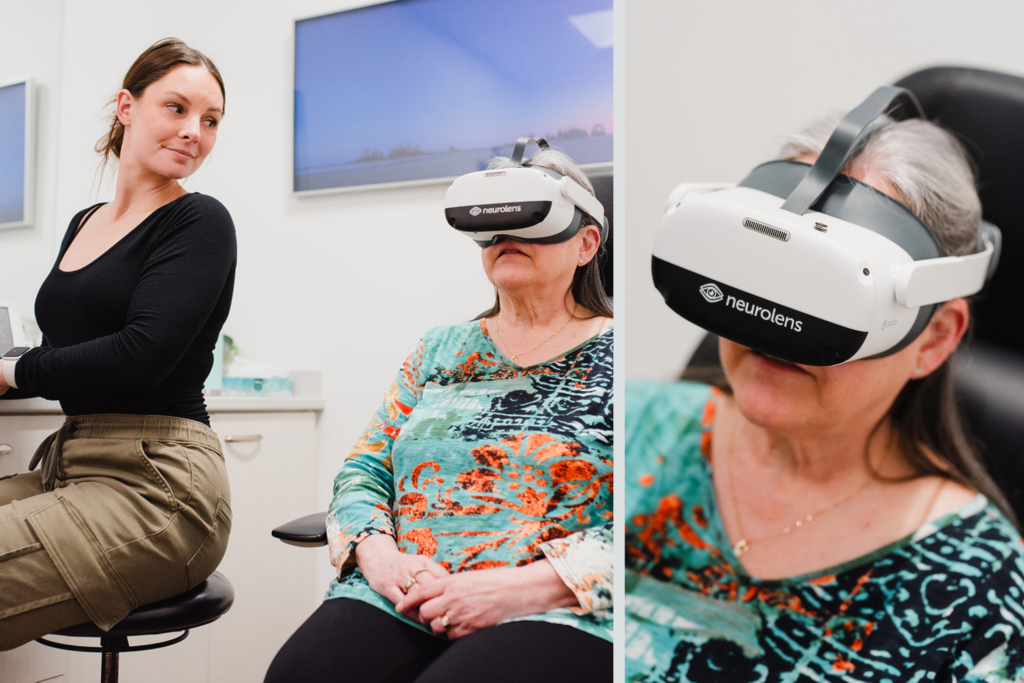
- Two-minute alignment measurement: You look into the Neurolens Measurement Device, a virtual reality style headset that measures how your eyes align at different distances. It’s quick and non-invasive.
- Comprehensive eye exam: Your optometrist checks your eye health and prescription to rule out other causes.
- Results and recommendation: You get your results before you leave. If Neurolens is a good fit, your optometrist explains how the lenses work and what to expect. If another approach suits you better, we’ll talk through that instead.
- Follow-up: If you go ahead, we schedule a follow-up phone consultation with your optometrist a few weeks after you pick up your glasses.
For more detail, see our full Neurolens testing process or what to expect at an eye exam. When you book your eye exam, mention your headaches so we can plan for Neurolens testing.
Who Is a Good Candidate for Neurolens?
Neurolens is generally best suited to adults aged about 18 to 59 who have regular symptoms during focused visual work. That often includes:
- Office professionals who spend most of the day at a computer and deal with eye strain, headaches, or neck tension
- Post-secondary students who spend long hours reading, researching, and attending online classes
- People with recurring headaches that seem tied to reading, screens, or other close work
- People whose updated glasses haven’t fixed the discomfort
- Frequent readers who notice blurring, losing their place, or fatigue during long reading sessions
Neurolens usually isn’t the right fit for people who already wear horizontal prism in their glasses, or for people with amblyopia (lazy eye) or nystagmus. Candidacy always comes down to your exam results and alignment measurements, not symptoms alone. If Neurolens isn’t right for you, we also look at dry eye, prescription changes, focusing problems, and screen habits.
Is Neurolens the Same as Blue-Light Glasses?
No. They’re designed for different things.
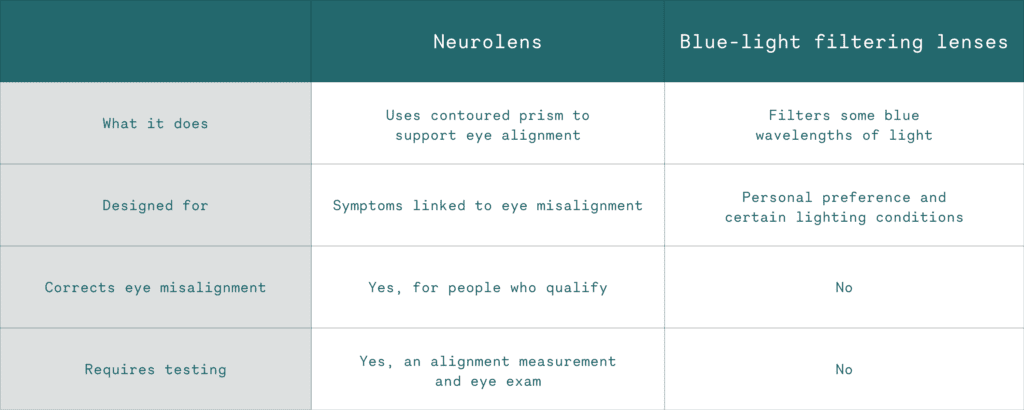
Some people like blue-light filtering lenses for comfort under certain lighting, and that’s a fine personal choice. On eye strain specifically, a 2023 Cochrane systematic review found that blue-light filtering glasses may not reduce short-term eye strain from computer use compared with standard lenses. If headaches or screen discomfort keep coming back, an eye exam is a better first step than relying on blue-light glasses alone.
How Long Does It Take to Adjust to Neurolens?
Most people need an adjustment period of up to two weeks, and many notice relief from symptoms as early as four weeks. Everyone adapts at their own pace.
To get off to a good start:
- Start wearing your new glasses the morning after pickup, when your eyes are well rested.
- Wear them consistently through the day, unless your optometrist tells you otherwise.
- Turn your head toward what you want to see instead of moving only your eyes, especially when looking to the side.
In the first few days, it’s normal to notice some distortion at the edges of the lenses, a slightly warped floor when you look down through the bottom of the lens, or a change in depth perception that makes objects seem closer or farther away. These usually settle as your eyes adapt.
If your symptoms get worse or you’re still struggling to adapt, call us at (250) 374-2441. Our team will troubleshoot with you, and if needed, the lenses can be remade. You’ll find more tips in our patient guide to Neurolens.
When Should You See a Doctor About Headaches?
Eye strain and binocular vision problems cause some headaches, but headaches have many possible causes. If yours are frequent, persistent, getting worse, or changing in pattern, see your family doctor or another appropriate healthcare professional.
Get emergency medical care right away for:
- A sudden, severe headache, especially the worst headache you’ve ever had
- A headache with weakness, numbness, confusion, trouble speaking, or a drooping face
- A headache with fever and a stiff neck
- A headache after a head injury
- Sudden vision loss or sudden double vision
For sudden flashes of light, new floaters, eye pain, or an eye injury, seek urgent eye care. Nicola Eye Care offers emergency eye care in downtown Kamloops.
If your headaches regularly show up after reading or screen time, a comprehensive eye exam can help show whether your eyes are contributing. Eye care is one part of your overall health, and we’ll refer you for further medical assessment when needed.
Neurolens and Eye Strain Headache FAQs
What is Neurolens?
Neurolens® is a prescription lens that uses contoured prism to help the eyes stay comfortably aligned. The amount of prism changes from the top of the lens to the bottom, supporting your eyes at both distance and near. It’s prescribed after an alignment measurement and a comprehensive eye exam.
Does Neurolens really work for headaches?
Neurolens can help some people whose headaches are linked to eye misalignment. A 2024 manufacturer-funded randomized trial found a statistically significant improvement in headache impact compared with control lenses, though the average change was below the study’s threshold for clinical significance. Results vary, and testing shows whether you’re a candidate.
Can eye misalignment cause headaches?
Yes, for some people. When the eyes are slightly misaligned, the eye muscles work harder to keep one clear image, especially during reading and screen use. That extra effort can contribute to headaches, tired eyes, and neck tension. Many other things cause headaches too, so an eye exam helps find the source.
Why do I get headaches after screen time even with new glasses?
Glasses correct how clearly you see, but they don’t always address how well your eyes work together. A small eye misalignment, dry eye, glare, or posture can all cause headaches even with an up-to-date prescription. A comprehensive eye exam with binocular vision testing can show which factors apply to you.
How do I know if my headaches are coming from my eyes?
Headaches linked to your eyes often show up during or after reading or screen use and get worse later in the day. They can come with tired eyes, blurry or moving words, or neck stiffness. Only an eye exam can confirm the cause, so book one if this pattern sounds familiar.
Is Neurolens the same as blue-light glasses?
No. Blue-light glasses filter certain wavelengths of light. Neurolens uses contoured prism to support eye alignment and is prescribed after testing. Blue-light filtering lenses don’t correct eye misalignment, and research suggests they may not reduce short-term eye strain from computer use.
How is Neurolens different from regular glasses?
Regular glasses correct refractive errors like nearsightedness and astigmatism so you see clearly. Neurolens includes your prescription when needed and adds contoured prism to reduce the effort it takes your eyes to stay aligned. It comes in single vision, computer, and progressive designs and fits most frames.
Does insurance cover Neurolens?
Coverage depends on your plan. Many extended health benefits plans cover part of the cost under vision care or therapeutic lenses. Nicola Eye Care can provide detailed receipts for your claim or bill your plan directly. Check with your provider to confirm your coverage.
Where can I get Neurolens in Kamloops?
Nicola Eye Care is the only clinic in Kamloops offering Neurolens. We’re at 101-286 St. Paul Street in downtown Kamloops, open Monday to Saturday from 7:30 a.m. to 5:00 p.m. Neurolens testing is part of a comprehensive eye exam, which you can book online.
Find Out What’s Behind Your Headaches
If headaches, tired eyes, or trouble concentrating have become part of your workday, you deserve to know why.
Screen-related discomfort rarely has one simple cause. For some people, better screen habits make the difference. Others need updated glasses, dry eye treatment, or a closer look at how their eyes work together. We take the time to find what’s driving your symptoms and recommend care that fits you.
Book your comprehensive eye exam at Nicola Eye Care and find out what’s affecting your visual comfort.